
You run two businesses at once, and most tools are only built for one of them.
An AV integrator is a project business and a recurring-revenue business running inside the same company, often inside the same client, at the same time. A design-build job has equipment, labour and milestones and ends when the room is handed over. A maintenance agreement on the system you installed two years ago never ends, and it does not care that you are mid-install on a different client’s boardroom this week. Most of the software built for this industry is good at one half. Project-management tools do not know how to bill a monthly agreement. PSAs built for break-fix IT do not know what a milestone payment is. So you end up running two or three systems and reconciling them by hand, or by memory, which is worse.
Argos holds projects, tickets, contracts, CRM, quoting from a live rate card and vendor parts, and monitoring against the same client record. Not because we read a whitepaper about convergence — because we were the business that needed it, and nobody would sell it to us whole.
We did not start as a software company. We started like you.
Intelligent Automation was founded in 2013• as an AV integration business — Crestron, RTI, Savant, Lutron, data racks, structured cabling build-outs. Those clients are still supported today; this is not a company that pivoted away from the trade and kept the logo.
As IoT devices multiplied in the buildings we were already wiring, we started securing them with enterprise-grade tools and process, because the client who trusted us with their equipment rack started asking who was watching the devices on it.
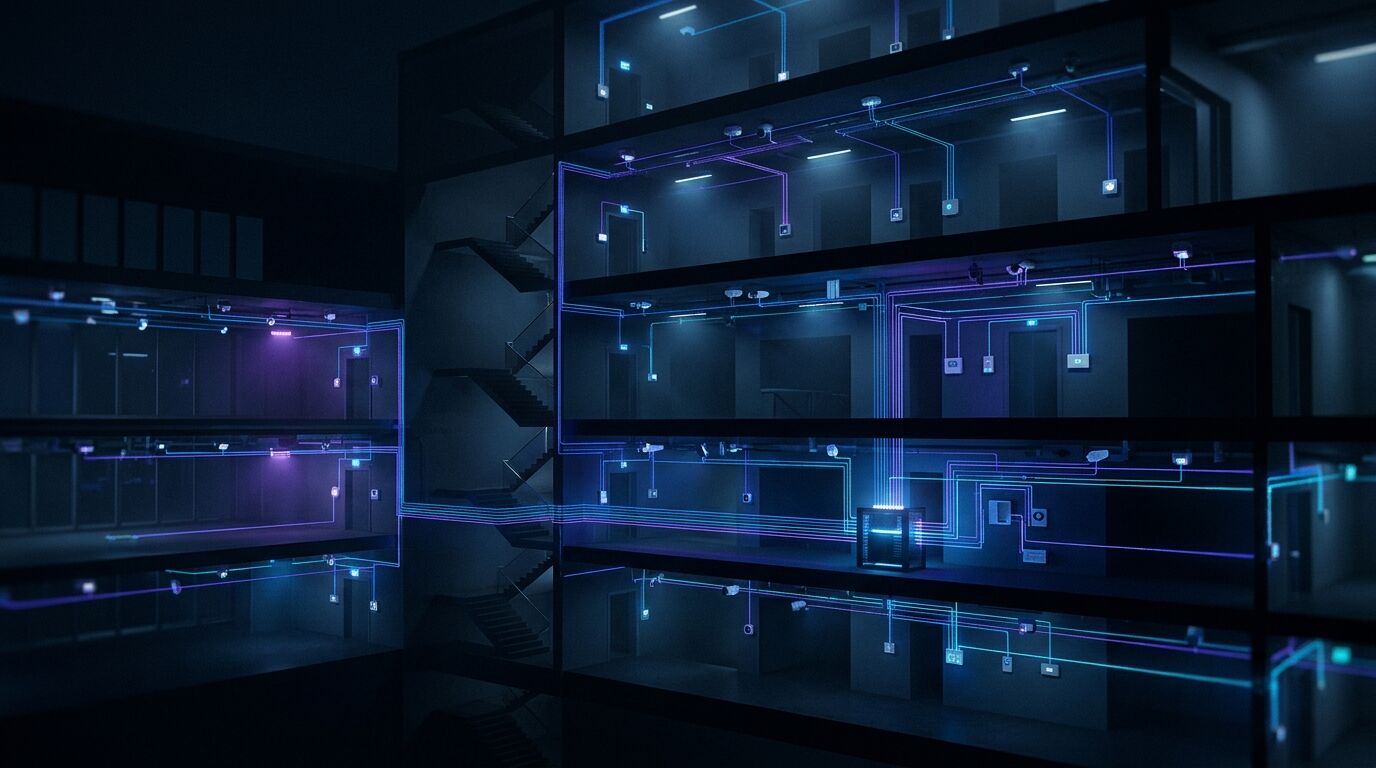
That work became a managed services practice. The managed services practice became a managed security practice. Argos OS is the system we had to build to hold all three without the seams showing, because nobody sells that system whole — you assemble it symptom by symptom, or you build it.
That distinction matters more than it sounds like it should. The major PSA and RMM platforms in this market — Datto, ConnectWise, Kaseya — were built by acquisition: a ticketing company buys a monitoring company buys a documentation company, and each one keeps its own data model, its own login, its own idea of what a “client” record contains. Argos was assembled by evolution instead — one business, growing one capability at a time on top of the same client record it started with in 2013. The spine is shared because it was never retrofitted. That is not a claim a competitor can match by announcing a roadmap; it is a question of how the company came to exist, and the answer does not change.
Every competitor you will evaluate this quarter can claim it was “built by an MSP.” Plenty were. None of them can say they wired the room first. Since 2013• the order here has been install, then secure, then manage, then monitor — Crestron and Lutron programming and structured cabling first, enterprise-grade IoT security next as the devices in those same buildings multiplied, a managed-services practice after that, and a managed-security practice after that. A platform born “IT-first” treats the rack as an edge case to be supported eventually. This one treats the rack as the reason the rest of the company exists.
our own environmentThe first AV integrator on Argos is running it right now, on exactly the modules it needed first.
Our first external Argos OS customer — an AV integrator — is mid-trial today. A second AV integrator is interested. Zero are yet paying•, and we would rather you hear that from us than assume otherwise from a page that implies a customer base it does not have. We are not asking you to believe this because we are the first; we are telling you we are the first because that is the truth and the honesty is the point of this site.
What the trial actually uses is the detail worth sitting with: support services, maintenance, project management, CRM, and monitoring. Not the security stack — not yet, and nobody made them. “They don’t need to use it all to derive value,” is how our CEO, David Levin, put it internally, and the trial is the evidence that the sentence is true rather than a line for a deck. You can adopt one module or nine. The module you add in month six already shares a spine with the one you bought in month one, because it was never a separate acquisition bolted onto a core — there is no integration project waiting for you when you decide you want the next piece.
While that proves out, the platform itself is not idle or demo-only: it runs Intelligent Automation’s own 24•-client managed-services practice daily, including the AV clients that predate the MSP. That is our own proof point, not yours yet — which is exactly why the mid-trial AV integrator matters more to this page than any number we could publish about ourselves.
stated plainly, not inferredKeep Domotz. We mean that literally.
If you monitor AV and network gear today, there is a very good chance it is through Domotz, and you did not choose it by accident — it is built for exactly this equipment and you trust what it tells you. Argos does not ask you to rip that out and replace it with something of ours that has not earned the trust Domotz already has. Argos Eyes does not monitor anything itself. It is the intake layer that turns an alert — from the monitoring tool you already run — into a ticket, automatically, in the same client record that holds the project, the contract and the quote for that site.
Today that intake recognizes alerts from Domotz and ten other sources side by side — Datadog, Grafana, Prometheus Alertmanager, Microsoft Sentinel, SentinelOne, Microsoft Defender, CrowdStrike Falcon, AlertOps, xMatters and Uptime Kuma — each wired through a real webhook setup template rather than a promise to “integrate eventually.” Domotz’s own description of the pattern is exactly what it does here: network and device alerts become tickets, wired through Domotz’s own Alert profiles > Notifications > Webhook setting. Several of these integrations resolve the ticket automatically once the originating alert clears, so a flapping device does not leave a stale ticket open for a technician to notice three days later. Eyes ships with Argos. It is not a line item you negotiate separately, and it is not a reason to abandon a monitoring tool that already does its job.
That is eleven alert sources, named specifically because an unnamed list is not a feature, it is a hope. If a tool you run is not on that list, say so before you sign up — we would rather tell you it is not there yet than let you find out mid-onboarding.
your monitoring, our ticketing — not a replacementThe equipment is the job. A register that stops at tickets and monitoring is describing half of what you actually do.
Monday starts with a quote, not a ticket. A client wants a boardroom refreshed — touch panels, a camera bar, new amplifiers. Vendor Connect reads current pricing off the manufacturer catalogue you already hold accounts with; Catalog carries the part numbers and lead times; Margins shows what the job actually nets before the quote goes out, not after the invoice reconciles against a spreadsheet nobody kept current; Orders tracks what you committed against what the vendor shipped, against the same client record the install will live in once it's done. For a business where the equipment is the job, software that treats procurement as someone else's problem is asking you to run the part of the business that carries the margin on a side system you have to reconcile by hand.
Tuesday is a truck roll on a maintenance agreement signed two years ago. Time Tracking logs the hour against that specific contract, not a generic bucket called “support” — and because Contracts and Service Catalog sit on the same spine, the hour traces back to the clause that actually governs it: what's covered, what's billable, what the SLA promised. Change Mgmt records what was touched on site, so the technician who opens that client next isn't guessing what changed since the install. It's the same discipline behind the 2,253 tickets resolved end to end• we count from our own practice — closed against a real contract row, not a ticket number nobody can trace back to what was promised.
Wednesday the client opens their own portal and sees the job without calling you. Open Client Portal, Portal Accounts, Branding and Navigation put your logo in front of them, not ours, over the same ticket, quote and project status your technicians are already reading — a client who can see where their boardroom build stands is a client who stops phoning to ask.
And the gear you installed in 2019 is the same record your technician opens when it fails this year: Assets, Checkouts, Consumables and Software Licenses track what's in the building and who holds the spare parts; IPAM, Domain Monitor and CMDB hold the network it sits on; Password Vault, Documents and Knowledge Base hold the rack diagram and the admin credential for it. Every one of those lookups lands in the same append-only history as the ticket and the invoice — part of the same 320,000+ hash-chained audit records• the rest of the platform writes to, not a separate log a different tool keeps on its own schedule. The same holds for the compliance paperwork a client's own IT department eventually asks for: it maps against the same 20 compliance frameworks• the platform tracks, mapped once and reused rather than retyped per client.
None of this is the security stack the first AV integrator in trial is not yet using. It's the half of the business that was never in question — the quote, the hour, the asset, the client's own view of the job — and it runs on one spine instead of the five or six separate logins most integrators are already carrying.
the week, not the module listThe honest version, including the parts that are not finished.
We have one external AV integrator mid-trial and one more interested. We have not run this with a second payer, a third, or a hundred. We are not going to write around that with a case study we do not have or a logo we are not allowed to use. What we can tell you is what is true of the platform itself: it carries 27• products across PSA, security, identity, compliance and documentation, it runs our own 24-client AV-and-MSP practice every day, and it exports everything you put into it, any day, at no cost — because we have been the customer standing there holding an empty box after switching platforms once already, and we built the exit on purpose.
The whole platform, white-labeled and free for 14 days•, no card and no onboarding fee, is the same offer every other prospective customer gets — an AV integrator does not get a different trial because this is a new page. After the trial, pricing is per technician, from $125 down to $101 a month as you grow•, published on the pricing page rather than gated behind a call. One rate covers run-and-secure for the modules the first AV integrator is already using; the security stack, when and if you want it, is the same shared spine, not a second system to reconcile.
don’t trust us. check us.Run support and maintenance on it first. Decide about security later, or never.
If you are a Crestron, RTI, Savant or Lutron shop fielding more support-contract requests than you have a system for, the question is not whether you need a PSA — it is whether the one you pick understands that your business is a project shop and a service shop wearing the same badge. We built Argos because we could not find one that did. If you want to see what the AV integrator in trial is actually running, ask us and we will show you the modules, not a slide about them.
Each of these answers a single question in full, and links back here.
-
How do you add recurring revenue to an install business?
Projects and service contracts against the same client record, with the equipment margin where you can see it. -
You already pay for Domotz. How does an alert become billable work?
Keep the monitoring you trust; eleven sources turn alerts into tickets, and several close themselves when the alert clears. -
Your client's IT department is asking what secures the AV devices.
We installed Crestron and Lutron before we secured IoT for a living — this is the problem we solved for ourselves first.